
France Market Alert: Euro Pressure, Payment Risk & Logistics Disruption for Exporters
France faces a fiscal squeeze, euro weakness, port strikes and retail disruption. Here's what exporters trading with France must do now on FX, payment safety and shipping timing.
1、 What Is Happening in France
Stocks, Bonds and the Euro Are Falling Together
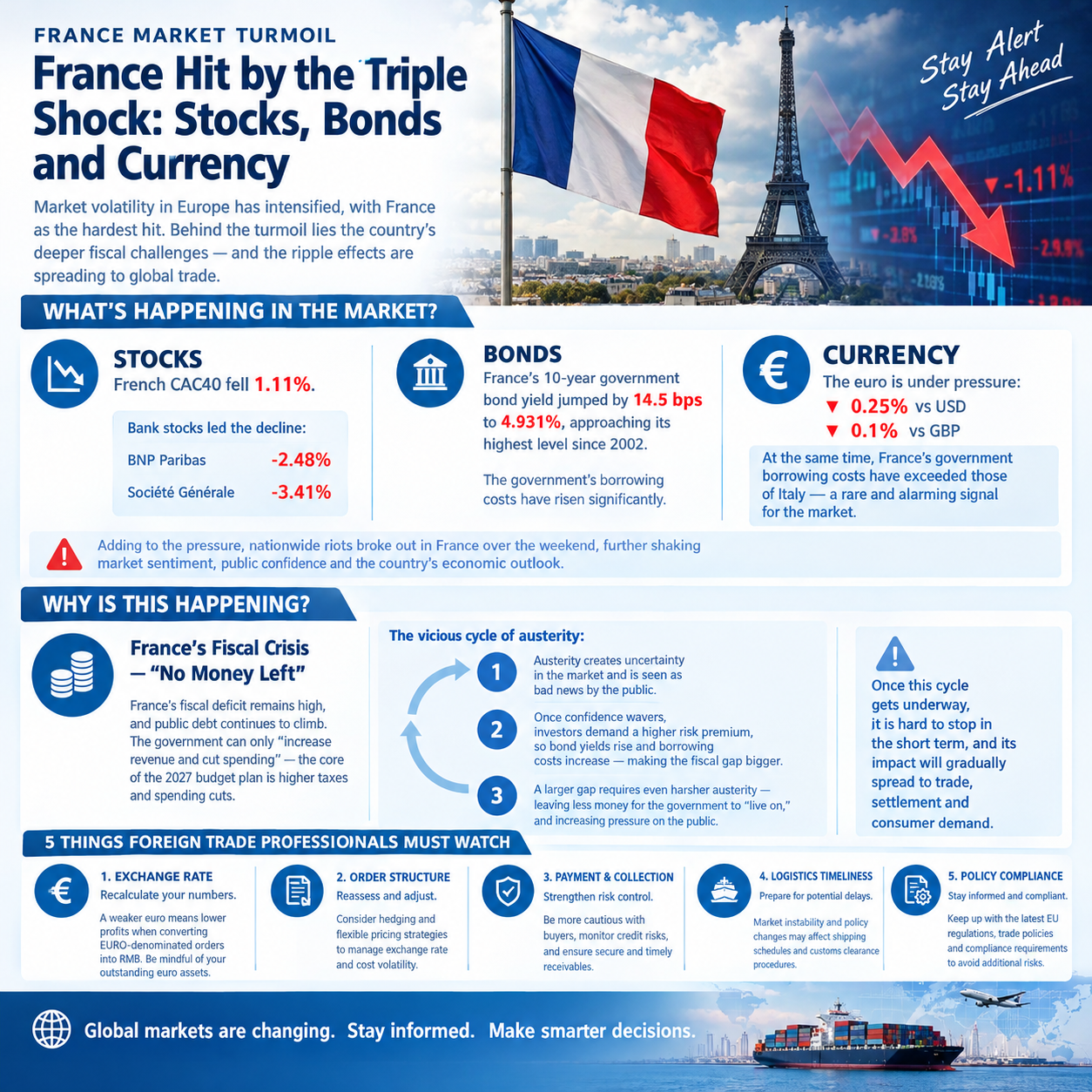
The CAC 40 fell 1.11%, led by banks — BNP Paribas down 2.48% and Societe Generale down 3.41%. The 10-year French government bond yield jumped 14.5 basis points to 4.931%, near its highest level since 2002. More tellingly, France now borrows more expensively than Italy — a signal that investors price French sovereign risk above Italy's for the first time since the euro crisis.
The root cause is fiscal: high deficits, rising public debt, and a 2027 budget built on tax hikes and spending cuts. Austerity feeds uncertainty, uncertainty feeds higher risk premiums, and higher premiums widen the fiscal hole. That loop is hard to stop once it starts.
2、Three Things Exporters Must Act On Now
FX, Payment Safety and Shipping Timing — Act First on These
Sub-point 1: Currency — Recalculate Your Margins
The euro is under pressure. With the EUR/CNY central parity at 7.5197 on October 21, 2026, versus a monthly average near 7.7651, the same euro receivable now converts into noticeably fewer yuan. Consider forward FX hedging or options to lock in a cost line. Shorten quote validity periods and add exchange-rate adjustment clauses to new contracts.
Sub-point 2: Payment Safety — Tighten Terms for French Buyers
Recent social unrest has hit French retail hard: over 1,500 shops damaged or looted, with losses estimated in the hundreds of millions of euros. Carrefour alone saw 50 stores damaged, 19 looted, with repair costs exceeding 10 million euros. If your French buyer is a bricks-and-mortar retailer or a small distributor dependent on foot traffic, its cash flow and solvency may deteriorate. Raise prepayment ratios, require bank guarantees or credit insurance, and proactively check receivables.
Sub-point 3: Logistics — Avoid Two Key Dates
French logistics face concrete disruption. The Port of Le Havre is suffering a major IT failure blocking container delivery and pickup. Marseille-Fos dockworkers struck on October 16. Nationwide port strikes are planned for October 30, and a cross-sector national strike affecting ports, rail and road is planned for November 5. Confirm whether in-transit cargo passes through Le Havre or Marseille-Fos, consider routing via Antwerp or Rotterdam, and build longer buffers into delivery schedules.
3、Policy Compliance Watch
One More Rule to Watch: France's Anti-Fast-Fashion Law
France's anti-fast-fashion law took effect on September 1, 2026. China's Ministry of Commerce has said the law, under the guise of environmental protection, imposes discriminatory restrictions and may violate WTO non-discrimination principles. If your business involves fast-fashion apparel or textile e-commerce with France, assess the added compliance costs and potential penalty exposure.
4、The Risk Chain in One Line
How the Risk Travels
Fiscal negative loop → bond market repricing → euro pressure → cautious banks → real-economy shock (unrest + strikes). The most effective short-term actions: hedge FX losses, tighten terms for small French buyers, and avoid the October 30 and November 5 logistics windows.
Get the France Market Risk Briefing
Subscribe for updates on French fiscal risk, euro moves and logistics alerts affecting exporters.
Explore the data
Turn this market signal into a repeatable workflow
Search companies, products, routes and shipment activity with GlobalBigData.
Request a demo